Graičiūnas on span of control
One more person in the team is not one more thing to worry about. In 1933 Graičiūnas showed how many it really adds — and the gslk org tree prints that number beside every node.
The formula showing that a manager's relationships grow faster than their team — and when that becomes a problem.
Why two people is six relationships
Almost everyone counts three: you and Rūta, you and Tomas, Rūta and Tomas. Graičiūnas is not counting the same thing. He is counting the conversations you have to hold in your head, and there are three kinds of them.
- Direct single2
- You and Rūta
- You and Tomas
You and one person. Nobody else is present.
- Direct group2
- You and Rūta, while listening: Tomas
- You and Tomas, while listening: Rūta
You and one person while another is listening. That is a different conversation from the private one — who is in the room changes what gets said.
- Cross2
- Rūta → Tomas
- Tomas → Rūta
The two of them, without you. Counted both ways: Rūta leaning on Tomas is not the same event as Tomas leaning on Rūta.
Move the number. People go up one at a time. Relationships do not.
Person number 2 added 5 relationships.
| The formula | n = 2 |
|---|---|
| Direct single · n | 2 |
| Direct group · n(2n−1−1) | 2 |
| Cross · n(n−1) | 2 |
| C = n(2n−1 + n − 1) | 6 |
Graičiūnas never said how many people is too many. He said what one more costs. The decision is yours.
- The situation
Two people report directly to you: Rūta does the posters, Tomas books the room. It looks like two conversations.
- What the model says
Graičiūnas counts six, and you can say them out loud: you↔Rūta; you↔Tomas; you↔Rūta with Tomas in the room; you↔Tomas with Rūta in the room; Rūta→Tomas; Tomas→Rūta. Almost everyone counts three — you↔Rūta, you↔Tomas, Rūta↔Tomas — and that is exactly why he gets misread: he also counts the combinations where one speaks while the other listens, and each direction separately.
- What you do
Before you invite a third person, answer one question this week: would their work touch Rūta's and Tomas's? Two is 6 relationships, three is 18 — and where subordinates' work does not touch, Graičiūnas himself allows you to carry more.
Why this number is your problem, not Graičiūnas's
Count the conversations you have to keep in your head, not the people. Two people is six relationships. Four people is forty-four. Five is a hundred. One more person is never just one more.
That is why the day ends and your own work has not moved. Not because you are slow or disorganised. Because you took on more relationships than fit in one head, and no weekly planning system fixes that.
Clubs do not fall apart because the people are bad. They fall apart because somebody asked you something and you did not get back to them. That person did not ask a second time, quietly stopped turning up, and you found out two months later. Staying inside your span is not controlling less. It is the first time you are actually in control: everyone who comes to you gets an answer.
And this is the thing that will later separate a good leader from a bad one. The bad one keeps everything and calls it responsibility, because giving work away feels like losing grip. The good one notices they have stopped keeping up and splits the work while there is still something left to split. Noticing that you are overloaded is a skill, and you can start learning it today.
The honest exception, and it is his own: if your people's work does not touch — each doing their own thing, with nothing to coordinate — you can carry more of them. This is a question to ask yourself, not a rule somebody will come and audit.
| Reporting to you | Relationships to hold |
|---|---|
| 2 | 6 |
| 3 | 18 |
| 4 | 44 |
| 5 | 100 |
| 6 | 222 |
| 12 | 24 708 |
Going from four people to five: a fifth more hands, and two and a half times the complexity. His own figures: +20% capacity for +127% complexity.
What it claims
Graičiūnas counted relationships, not people: how many a supervisor must hold when n people report directly to them. The answer is R = n(2ⁿ⁻¹ + n − 1). One subordinate is 1 relationship. Three is 18. Five is 100. Eight is 1,080.
The number explodes because relationships come in three kinds, and only the first grows one at a time: talking to each person alone, what one subordinate thinks of another, and talking to one while the others are in the room. Every new person adds as many cross and group relationships as there are already people in the group.
Graičiūnas's own conclusion: the number of lateral divisions at each descending level should be restricted to a maximum of five and, most probably, only four. Going from four to five, he wrote, buys a 20% increase in working capacity for a 127% increase in complexity.
What the formula does not prove. It counts possible relationships rather than ones that happen, and treats them all as equally expensive; the 1933 text is a mathematical demonstration, not an empirical study. He made the exception himself: where subordinates' work does not touch, more of them can be carried. The principle itself was challenged by Herbert Simon in 1946 — a narrow span of control and a short chain of decision contradict each other, so neither is a law. So gslk shows the number and never scolds with it.
Who created it
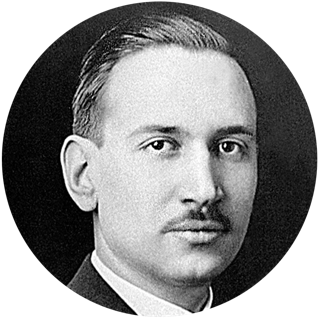
The whole story is in the text below. This is only its spine.
- 1898Chicago
Born to a Lithuanian emigrant family. American from day one.
- 1923–1925Chicago, New York
Finished his engineering degree and advised Chicago and New York companies on management.
- 1926Kaunas
Came to Lithuania and became technical director of the Metalas factory.
- 1929Paris
Met Lyndall Urwick at the management congress and asked for help putting the argument into English — his own English, he felt, was not good enough.
- 1933Geneva
'Relationship in Organization' — four pages in the institute's bulletin. Reprinted in Gulick and Urwick's collection in 1937, which is how a Lithuanian's paper ended up in the American management canon.
- 1938Kaunas
Gathered the Lithuanian Scientific Management Society and became its first chairman.
- 1944Kaunas
As the front moved west, he chose not to leave.
- 1945–1948Kaunas University
Taught construction management. His students remembered a lecturer who showed processes with movement, gesture and a shift of voice. Dismissed in 1948 as the campaign against 'cosmopolitanism' began.
- 1948Moscow
Renounced his US citizenship. The embassy told him he could leave alone; his wife, the actress and director Unė Babickaitė, had no citizenship. He stayed.
- 1951Lefortovo, Moscow
Both arrested. Charged with espionage for the United States and anti-Soviet agitation, sentenced to ten years; she to five.
- 1952Olžeras, Kemerovo oblast
Died in the Kamyšas camp, less than three months after the sentence. His burial place is unknown and the circumstances are disputed to this day.
- 1988
Rehabilitated.
An American-born engineer who could have stayed in Chicago and stayed in Lithuania instead. Vytautas Andrius Graičiūnas was born on 17 August 1898 in Chicago to a Lithuanian emigrant family; he studied at the University of Chicago, volunteered for the US war aviation service in France in 1917–1919, and completed his engineering studies in 1923. He came to Lithuania in 1926 as technical director of the Metalas factory in Kaunas, and from 1927 to 1935 advised companies in Germany, the Netherlands, Switzerland and France. At the Paris management congress of 1929 he met Lyndall F. Urwick, then director of the International Management Institute in Geneva, and asked for help putting the argument into English; "Relationship in Organization" appeared in that institute's bulletin in March 1933. In 1938 he gathered and chaired the Lithuanian Scientific Management Society in Kaunas. From 1945 to 1948 he was a docent in the Construction Faculty of Vytautas Magnus University (from 1946, Kaunas University), and was dismissed in 1948. In November 1948 he renounced his US citizenship so that he would not have to leave without his wife, the actress Unė Babickaitė. On 19 April 1951 both were arrested; he was charged with espionage for the United States and sentenced to ten years. He died on 9 January 1952 in a camp at Olžeras, Kemerovo oblast; the circumstances are disputed and his burial place is unknown. He was rehabilitated in 1988.
Why this is your problem
We have not written a practice step for this one yet. When we do, it will be as concrete as the rest.
Why gslk uses it
He is where the club's name comes from, and the only author on this list who taught at the university the club grew out of. But the choice is not only symbolic: almost nobody in a student club has studied management, and the first structural mistake is nearly always the same — ten people reporting directly to the president, who cannot work out why there is never enough time. Graičiūnas's arithmetic makes that cost visible before it is felt, and it does so with a number a student can check, not a score they have to trust.
Where it runs in the product
- /admin/org — the club's org tree: every node shows its number of direct reports, which is what the formula is computed from.
- /pagrindai/graiciunas-praktika — what to do with the number: departments, department leads, one forum instead of twelve private chats, and writing things down.
- Programme module 2: "Organisational structure and Graičiūnas's principles".
- Candidate requirements (/admin/path): a basic structure — the Graičiūnas org tree — is one of the six candidate criteria.
Source
Graicunas, V. A. (1933). „Relationship in Organization.“ Bulletin of the International Management Institute, Geneva, t. 7, 1933 m. kovas, p. 39–42. Perspausdinta: L. Gulick & L. Urwick (eds.), Papers on the Science of Administration (New York: Institute of Public Administration, Columbia University, 1937), p. 183–187.
Read the primary source ↗The primary source is in copyright. This page retells it in our own words and cites it rather than reproducing it.
These works are related to the one you just read — and not by accident:
same author
same competency: Span and structure
same competency: Span and structure
same competency: Span and structure
Of the ten gslk competency domains, this work grounds:
The same work written for a member: what to do with it in the club.
Links to publishers and libraries. There are no links to unauthorised copies here, and there will not be.
- The Lithuanian national encyclopaedia on V. A. Graičiūnas
- A. G. Bedeian (1974) — the English biographical note, Academy of Management Journal
- The arrest, the trial and the death in the camp — the fullest public account
Links open in a new window.